
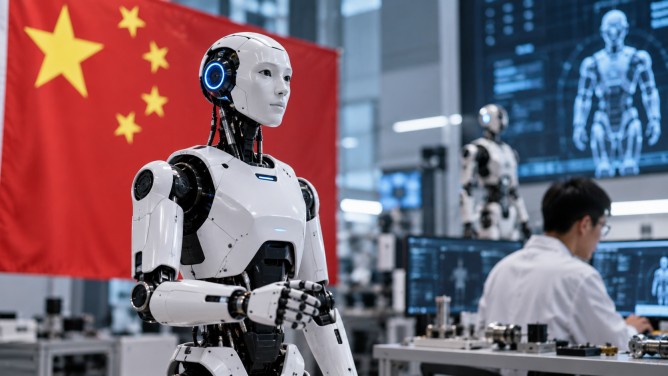
The humanoid robotics industry is on the cusp of a significant evolution, driven by the rapid advancements in embodied intelligence by Chinese firms. This progress was showcased at the recent World Humanoid Robot Games in Beijing, where robots crafted by Chinese companies amazed spectators by excelling in various athletic events. Remarkably, some of these machines broke records previously held by humans, including Usain Bolt’s legendary 9.58-second 100-meter sprint and Wayde van Niekerk’s 43.03-second 400-meter run.
This swift advancement has fueled a competitive environment among Chinese robotics companies eager to dominate the burgeoning industry. It has also sparked a pivotal question within the tech community: Have we reached the “iPhone moment” for humanoid robotics? The phrase, popularized by Nvidia CEO Jensen Huang in 2023, denotes a groundbreaking technological leap that propels an innovation from a novel idea to mainstream adoption, revolutionizing industries and user experiences alike.
Wang Xingxing, the founder and CEO of Unitree Robotics, a leading name in China’s humanoid robot manufacturing scene, provided his perspective on when embodied intelligence might hit such a transformative milestone. Speaking at the 2026 World Robot Conference in Beijing on August 20, Wang suggested that the industry could experience a breakthrough similar to the “ChatGPT moment” in two to three years, though he acknowledged that a slower pace could extend this timeframe to five to ten years.
The day before Wang’s comments, Unitree Robotics made a striking debut on the Shanghai Stock Exchange’s STAR Market. The company’s shares soared, closing 460 percent higher, underscoring the market’s strong confidence in the future of humanoid robotics. This financial performance reflects the growing anticipation and belief that embodied intelligence could soon reshape the technological landscape.