
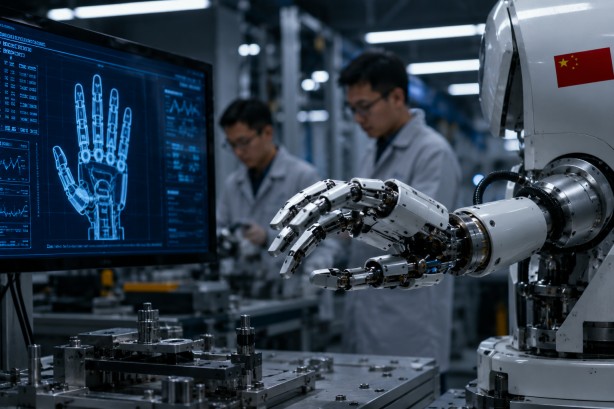
In a significant push towards advancing humanoid robotics, Chinese companies are focusing on developing highly dexterous robotic hands. This technology is considered one of the most challenging aspects of creating humanoids, with its potential to revolutionize applications in homes, healthcare, and industries.
Startups in China are leveraging artificial intelligence and the country’s robust manufacturing prowess to create robotic hands that can perform intricate tasks such as grasping objects, using tools, and managing daily activities. The integration of AI with manufacturing is seen as a crucial step in making humanoid robots more practical for everyday use.
Experts highlight that mimicking the flexibility and precision of human hands is more complex than constructing other parts of humanoid robots. Developers face numerous challenges, including designing compact motors and sensors for hardware and creating software that can interpret touch, pressure, and execute complex movements.
China has positioned itself as a leader in the global robotics manufacturing arena, thanks to its advanced supply chain and government-supported emphasis on “embodied AI.” This thriving robotics ecosystem is fostering rapid innovation, resulting in the development of robotic hands, wearable sensor gloves, and AI systems capable of learning human movements through real-world data.
Researchers assert that enhancing the dexterity of robotic hands is pivotal for creating robots that can perform a wide array of tasks, from household duties to industrial operations and advanced prosthetic applications. Industry leaders believe that ongoing progress in AI and robotics could eventually enable humanoid robots to work more seamlessly alongside humans, unlocking new possibilities in manufacturing, healthcare, and consumer services.