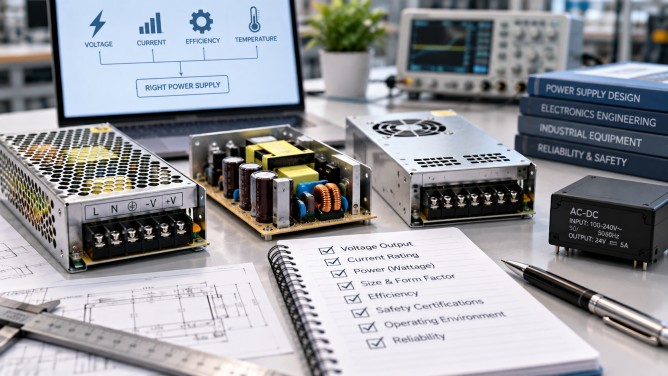
When selecting an internal power supply, it’s essential to look beyond the rated wattage. Key factors such as equipment voltage, operational and inrush currents, environmental conditions, cooling needs, and protection features play a crucial role in ensuring reliable and safe operation. Before making a purchase, it’s advisable to review the equipment’s datasheet and connection requirements, calculate the total load of all components that might operate simultaneously, and consider a practical power reserve of around 20–30%. For instance, equipment consuming 600 W under normal conditions may necessitate a power supply rated between 720–780 W, depending on startup requirements and operating conditions.
Inrush current demands special attention, particularly for equipment like motors, pumps, fans, and drives, which can require substantially more current during startup than in regular operation. The chosen power supply should manage these temporary current spikes without causing voltage drops or unexpected shutdowns. Voltage selection is another critical aspect, with common DC output voltages including 5 V, 12 V, 24 V, and 48 V, each serving different applications ranging from sensors and microcontrollers to industrial controls and higher-power uses. Matching the voltage to the equipment’s operating requirements and considering factors like cable length and voltage drop, especially in low-voltage systems, is vital.
The type of power supply—whether a standard unit, a UPS, or a battery—depends on the equipment’s operating mode and backup needs. While a standard power supply converts incoming electricity to the necessary DC voltage, a UPS provides backup during interruptions, and batteries offer energy for autonomous operation. DC-DC converters are employed to adjust one DC voltage to another, such as converting 24 V to 5 V for delicate electronics. For battery-powered systems, considerations like voltage, capacity, discharge characteristics, temperature, and cycle life are essential. Lithium-ion batteries are popular for compact equipment due to their high energy density, though their service life is influenced by temperature, charging conditions, and depth of discharge.
Efficiency and reliability are vital for UPS systems, which typically achieve efficiencies of 95–99% depending on the model and load. Evaluating efficiency under actual operating conditions is preferable to relying solely on maximum ratings. For critical equipment, factors such as switching time, output waveform, battery status, and safeguards against overtemperature, overload, and short circuits are important. The operating environment also significantly affects power supply performance. Heat buildup inside an enclosed cabinet can impact component life and reliability, necessitating unobstructed ventilation and dust-free fans or filters.
Safety and protection features should be thoroughly assessed, considering safeguards against overload, short circuits, overvoltage, and overheating to prevent equipment damage and ensure system reliability. Compliance with electrical safety standards like IEC 62368-1 may be necessary, depending on the application. For LED applications, attention to output voltage, strip length, current requirements, and cable voltage drop is crucial to avoid flickering, excessive heat, or inconsistent brightness. IP20-rated switching power supplies suit indoor installations without water exposure, providing protection against solid objects but not against moisture or dust, thus requiring appropriate placement in electrical cabinets or protected environments.
Legal Disclaimer:
The information contained in this article has been provided by independent third-party contributors, clients, or content partners. We do not independently verify the accuracy, completeness, legality, ownership, licensing, or reliability of submitted content, including text, images, videos, trademarks, or other media materials. The submitting party is solely responsible for ensuring that all content, including images and media assets, complies with applicable copyright, trademark, licensing, and intellectual property laws. We disclaim liability for any unauthorized use of copyrighted or proprietary materials by third parties. If you believe that any content published on this platform infringes your intellectual property rights, kindly contact the author above for prompt review and resolution.