
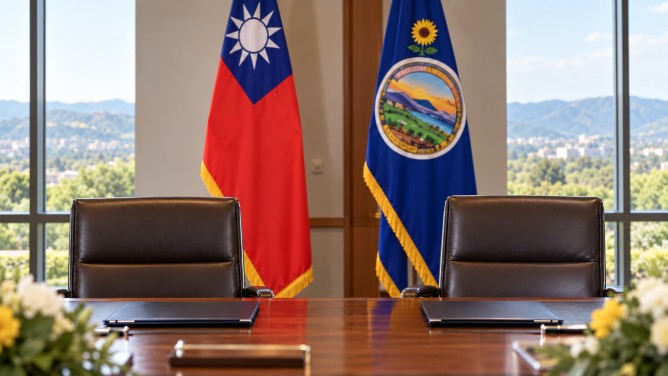
Taiwan and the U.S. state of Kansas have taken a significant step to enhance economic cooperation by signing a memorandum of understanding (MOU) aimed at strengthening trade ties across several key industries. The agreement, signed at the Kansas State Capitol by Debby Huang, Director-General of Taiwan’s representative office in Denver, and Kansas Lieutenant Governor David Toland, targets sectors such as aerospace, aviation, biotechnology, animal health, precision agriculture, and advanced air mobility.
This MOU underscores a mutual commitment to developing beneficial partnerships and expanding commercial opportunities between Taiwan and Kansas. The collaboration is expected to lay the groundwork for future business and institutional relationships in both regions. Kansas officials have previously engaged with Taiwanese counterparts to discuss potential cooperation in areas including investment, advanced technology, education, and talent development.
In parallel developments, the University of North Georgia has unveiled plans to establish a Taiwan studies center. This initiative aims to bolster academic cooperation between Taiwan and the United States, focusing on international relations, defense education, and Indo-Pacific security through research, policy discussions, and educational exchanges.
Taiwanese representatives have emphasized the importance of maintaining stability across the Taiwan Strait due to Taiwan’s crucial role in global semiconductor and advanced technology supply chains. This focus on stability is part of a broader strategy to deepen Taiwan’s economic, educational, and strategic partnerships with the United States and other international partners.
Looking ahead, Taiwan and its international partners are preparing for next year’s activities under the Global Cooperation and Training Framework (GCTF). These planned events will cover topics such as maritime security, disaster preparedness, supply chain resilience, and artificial intelligence, further reflecting efforts to promote cooperation in emerging technologies and regional security.