
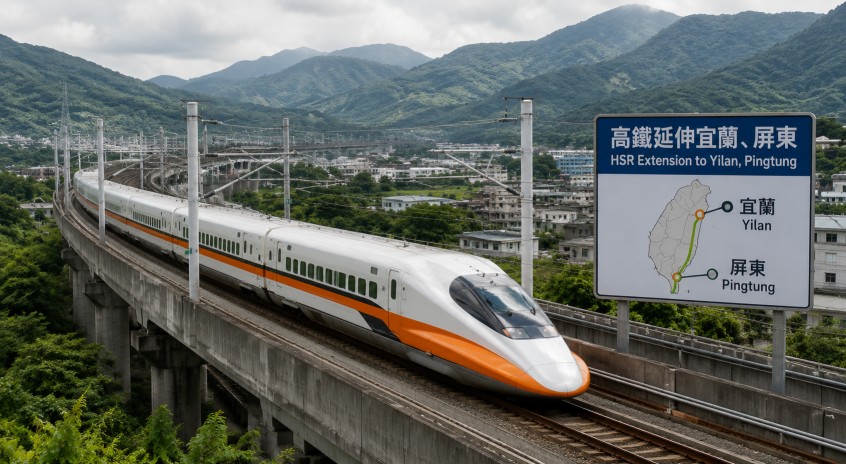
Taiwan’s government has greenlit two significant high-speed rail expansions, set to enhance the nation’s connectivity. The Executive Yuan has sanctioned the development of a new high-speed rail line to Yilan County and another that will stretch from Kaohsiung to Pingtung County, marking a substantial step forward in Taiwan’s transportation infrastructure.
Premier Cho Jung-tai has given the nod to the 60.6-kilometre extension from Nangang to Yilan, a venture projected to cost NT$352.2 billion (US$10.9 billion). This new line aims to drastically cut travel times between Taipei and Yilan to around 28 minutes, a considerable improvement over current train services. The planned route begins at Nangang HSR Station in Taipei and traverses several districts of New Taipei City, including Sijhih, Pingsi, Shuangsi, and Gongliao, before reaching Yilan through Toucheng and Jiaosi townships, eventually ending near the Yilan County Government complex. This terminal will offer seamless connections to the existing Yilan Railway Station.
The construction of this line is slated for completion by 2037. According to the Railway Bureau, daily ridership is expected to reach approximately 27,000 passengers on weekdays and up to 60,000 on weekends by 2051, underscoring the anticipated demand for this new route.
Additionally, the Executive Yuan has approved a 26.22-kilometre extension that will link Zuoying HSR Station in Kaohsiung with a proposed station in Lioukuaitso, Pingtung City, via Kaohsiung Railway Station. Authorities are targeting the completion of the project’s second-stage environmental impact assessment by next year, indicating progress towards enhancing the southern region’s rail connectivity.
These rail expansions are integral to the government’s broader ambition of establishing a comprehensive national rail network, enabling travel across Taiwan in four 90-minute segments. This vision also includes plans to upgrade the Hualien–Taitung railway to a double-track electrified line and to enhance the South Link Line between Taitung and Pingtung. Such improvements aim to boost capacity, fortify resilience against extreme weather conditions, and advance the overall infrastructure of the island’s transportation system.