
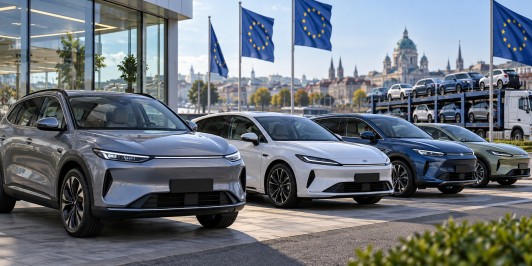
The rapid increase in sales of Chinese-made hybrid vehicles in the European Union is intensifying competitive pressures on local car manufacturers. With hybrids now making up nearly 37% of the European car market, the influx of affordable Chinese models is challenging the dominance of European brands and prompting regulatory concerns in Brussels.
Chinese automotive companies like BYD, Chery, and Leapmotor are gaining significant market share, with Geely leading as the largest Chinese car group in Europe. BYD has achieved remarkable growth, selling approximately 177,000 vehicles in the EU, while Geely’s sales reached about 205,000 vehicles in the first eight months of 2026.
This surge follows the European Union’s 2024 implementation of anti-subsidy tariffs on Chinese electric vehicles, which inadvertently boosted the presence of hybrid models exempt from these tariffs. As a result, sales of Chinese-made fully hybrid vehicles soared from just 659 units in 2022 to 160,662 in the first seven months of 2026. Plug-in hybrid sales also saw a substantial rise, increasing from 56,706 units in 2022 to 217,764 in the same period this year.
The European Commission is now urging China to voluntarily limit its hybrid vehicle exports to the EU. Without an agreement, the EU may consider introducing safeguard measures such as quotas to protect its automotive industry. The growing trade imbalance with China remains a critical issue as the EU seeks to maintain the competitiveness of its domestic car manufacturers.
The expansion of Chinese hybrid vehicle imports highlights a shifting landscape within the EU market, where fully electric vehicles currently account for just over 21% of sales. As Chinese manufacturers continue to establish a foothold, the EU faces complex challenges in balancing free trade with protecting its local automotive sector.