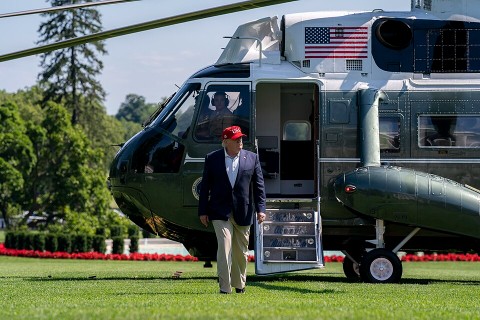
In a move that could complicate US-China relations, President Donald Trump stated on Wednesday his intention to engage in conversation with Taiwan’s President Lai Ching-te. Speaking to reporters at Joint Base Andrews in Maryland, Trump expressed, “I’ll speak to him. I speak to everybody … We’ll work on that, the Taiwan problem.” This declaration marks a significant step, as direct communication between US and Taiwanese presidents has been rare since the US shifted diplomatic recognition from Taipei to Beijing in 1979. The Taiwanese foreign ministry has responded positively, indicating President Lai’s willingness to converse with Trump.
This is not the first time Trump has suggested such a dialogue. His comments come just a week after meeting with China’s leader Xi Jinping, dispelling any notion of a verbal misstep. Despite the lack of a scheduled call, the potential for such a conversation has already raised concerns in Beijing. Historically, China has not hesitated to express its displeasure at US-Taiwan interactions, viewing Taiwan as a part of its territory and opposing foreign interference. The Trump administration’s military support for Taiwan, including the approval of significant weapons sales, has already been a point of contention between the US and China.
Adding complexity to the situation, Trump has not yet decided on a substantial arms deal to Taiwan, worth up to $14 billion, leaving US support for the island uncertain. Meanwhile, reports suggest that Beijing is withholding approval for a proposed visit by Pentagon official Elbridge Colby, contingent on Trump’s decision regarding the weapons sale. This strategic maneuver by China underscores the delicate balance of power and diplomacy involved in US-Taiwan relations.
Trump’s approach to Taiwan has been characterized by mixed messages. While he has praised his relationship with Xi Jinping, his reference to the “Taiwan problem” aligns with Beijing’s rhetoric. Despite this, President Lai remains steadfast in his stance, emphasizing Taiwan’s commitment to maintaining stability across the Taiwan Strait. Lai, perceived by China as a separatist, reiterated Taiwan’s democratic values and the importance of resisting any attempts of annexation. He highlighted that Taiwan’s people cherish their democratic and free lifestyle, urging that these should not be seen as provocation.
The strategic importance of Taiwan to the US is underscored by its position as the fourth-largest US trading partner, primarily due to its advanced semiconductor exports. US law mandates the provision of defensive support to Taiwan, and both Republican and Democratic lawmakers continue to advocate for ongoing weapons sales. As the situation develops, the potential conversation between Trump and Lai remains a focal point in the broader geopolitical landscape, reflecting the complexities of modern international diplomacy.